
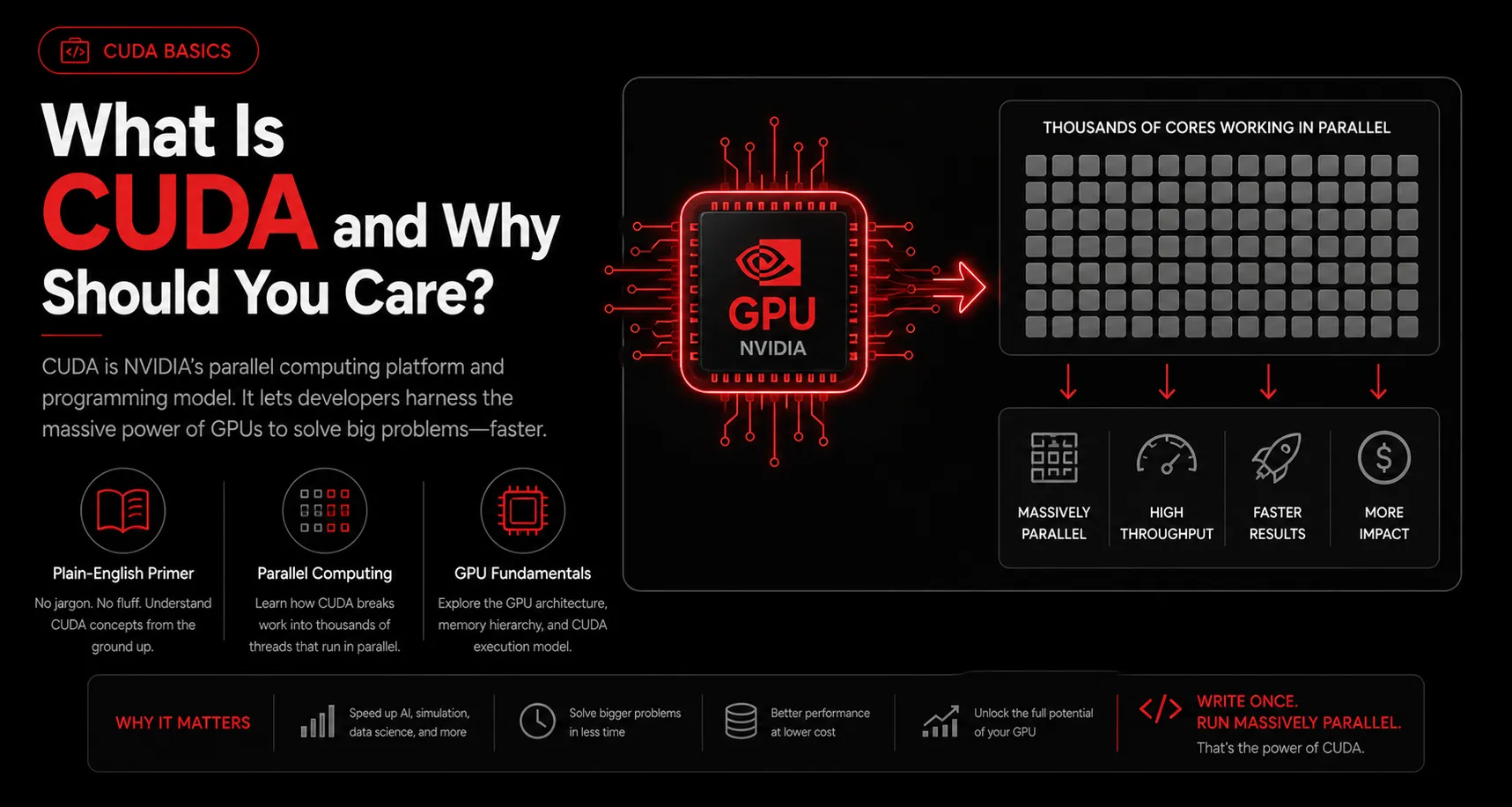
CUDA appears in every conversation about AI performance, but it is rarely explained simply. Here is what it is and why it matters, without the jargon.
CPUs versus GPUs
A CPU has a few very fast cores that handle tasks one after another extremely well. A GPU has thousands of smaller cores designed to do many similar things at once. If a CPU is a handful of expert workers, a GPU is a huge crew doing the same simple job in parallel.
What CUDA actually is
CUDA is the platform NVIDIA created so developers can write ordinary programs that run on that huge crew of GPU cores. Before CUDA, GPUs were mainly for graphics. CUDA opened them up to any workload that can be split into many parallel pieces.
Why parallelism wins
Many important tasks are naturally parallel. Training a neural network multiplies large matrices, processing an image applies the same operation to every pixel, and simulations update many particles at once. Doing thousands of these operations simultaneously is why a GPU can be 10 to 50 times faster than a CPU for the right workload.
Where it matters
CUDA underlies almost all modern AI. When you hear that a model trained on GPUs, CUDA is doing the work beneath frameworks like PyTorch and TensorFlow. It also powers scientific computing, financial modeling, and video processing.
The catch
Not everything is parallel. A task with steps that must happen in order sees little benefit. The art of GPU engineering is restructuring problems so the parallel parts dominate.
Key takeaways
- CPUs do few tasks fast; GPUs do many tasks at once
- CUDA lets developers run general programs on NVIDIA GPUs
- Parallel workloads like AI and simulation gain the most
- CUDA underpins frameworks such as PyTorch and TensorFlow
- The skill is restructuring problems to be parallel