
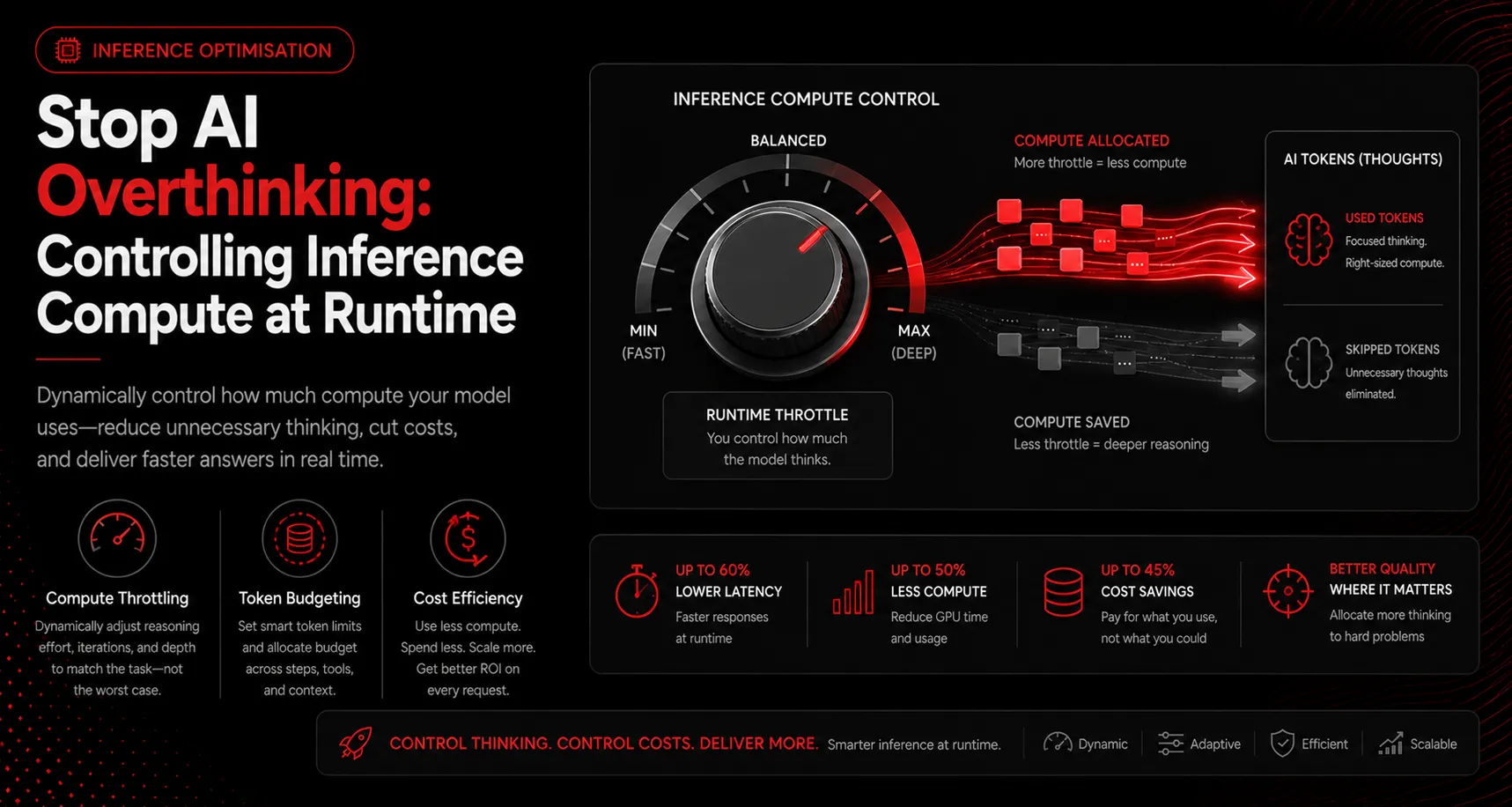
Reasoning models are powerful, but they often spend a paragraph of thought on a question that deserves a sentence. That overthinking is a direct cost, because every reasoning token is compute you pay for.
The overthinking tax
Chain-of-thought style models generate hidden reasoning before the final answer. On hard problems this is worth it. On easy ones it is pure waste, longer latency and higher cost for no better result.
Set a token budget
The simplest control is a cap on generated tokens per request. A budget bounds worst-case cost and latency. Tiered budgets, small for simple endpoints and larger for complex ones, match spend to need.
Scale reasoning to difficulty
Adaptive reasoning routes requests by complexity. A lightweight classifier or a cheap first pass decides whether a query needs deep reasoning or a direct answer. Most production traffic is easy and can skip the expensive path.
Exit early when confident
If the model reaches a confident answer before exhausting its budget, stop. Early-exit criteria based on confidence or a detected final answer prevent needless continuation.
Cache and reuse
Many requests repeat. Caching answers and reusing computed prefixes avoids paying for the same reasoning twice.
Key takeaways
- Reasoning tokens are a real and often hidden cost
- Cap generation with per-request token budgets
- Route by difficulty so easy queries skip deep reasoning
- Exit early once a confident answer is reached
- Cache repeated requests and shared prefixes